When Therapy Causes Harm
Therapy is meant to be a place of safety, yet many Autistic adults have experienced the opposite. This is the consequence that many Autistic people face when working with clinicians who lack appropriate training in autism specific practice.

Historically, autism has been approached through frameworks that prioritised behaviour correction and normalisation over wellbeing. Although some of the most extreme practices are now widely criticised, the assumptions that underpin them continue to shape everyday therapy, often in subtle and unexamined ways (Milton, 2012; Price, 2022).
Many counsellors working with Autistic adults may have received little to no specialist training in autism across the lifespan. As a result, they might unintentionally rely on neurotypical assumptions about communication, emotional expression, cognition, and motivation (Brosnan & Adams, 2022). These assumptions can sometimes lead to misunderstandings—and, in certain cases, harm.
Misunderstanding sensory distress as anxiety that needs to be challenged
For example, many Autistic adults experience intense sensory distress related to sound, light, texture, smell, temperature, or proximity to others. A common misunderstanding is interpreting this distress as:
irrational fear
cognitive distortion
avoidance behaviour
This framing prompts therapeutic suggestions like exposure, reframing, or "pushing through." For Autistic people, these strategies can increase distress and lead to burnout rather than build resilience (Hume, 2022; Price, 2022).
Sensory overwhelm in autism is frequently neurological and physiological, not fear‑based. When this distinction is missed, therapy itself can become unsafe when it leans into modalities like exposure-based therapy instead of establishing sensory safety.
Assuming emotional expression should look neurotypical
Another common example is misinterpreting Autistic emotions.
Autistic adults may:
experience very intense emotions while showing limited outward expression
struggle to identify or verbally label feelings (alexithymia)
appear calm while experiencing extreme internal distress
Untrained counsellors may conclude that the client:
lacks insight
is emotionally disconnected
is minimising or avoiding their experience
These assumptions often result in therapeutic goals focused on performing emotion, naming feelings more quickly, expressing them more visibly, or reacting in expected ways, rather than supporting regulation, interoception, or self‑understanding (Price, 2022).
Over time, this can increase shame and reinforce the perception that the Autistic person’s way of processing emotion is inadequate or wrong.
The burden of adaptation falls on the Autistic person.
Across many therapy experiences, Autistic adults describe leaving sessions with the sense that they are the ones who must change, rather than the environments, expectations, or systems around them (Camm‑Crosbie et al., 2019).
This reflects a broader pattern described in autism research: when misunderstandings occur between Autistic and non‑Autistic people, responsibility for repair is disproportionately placed on the Autistic person, a phenomenon known as the double empathy problem (Milton, 2012).
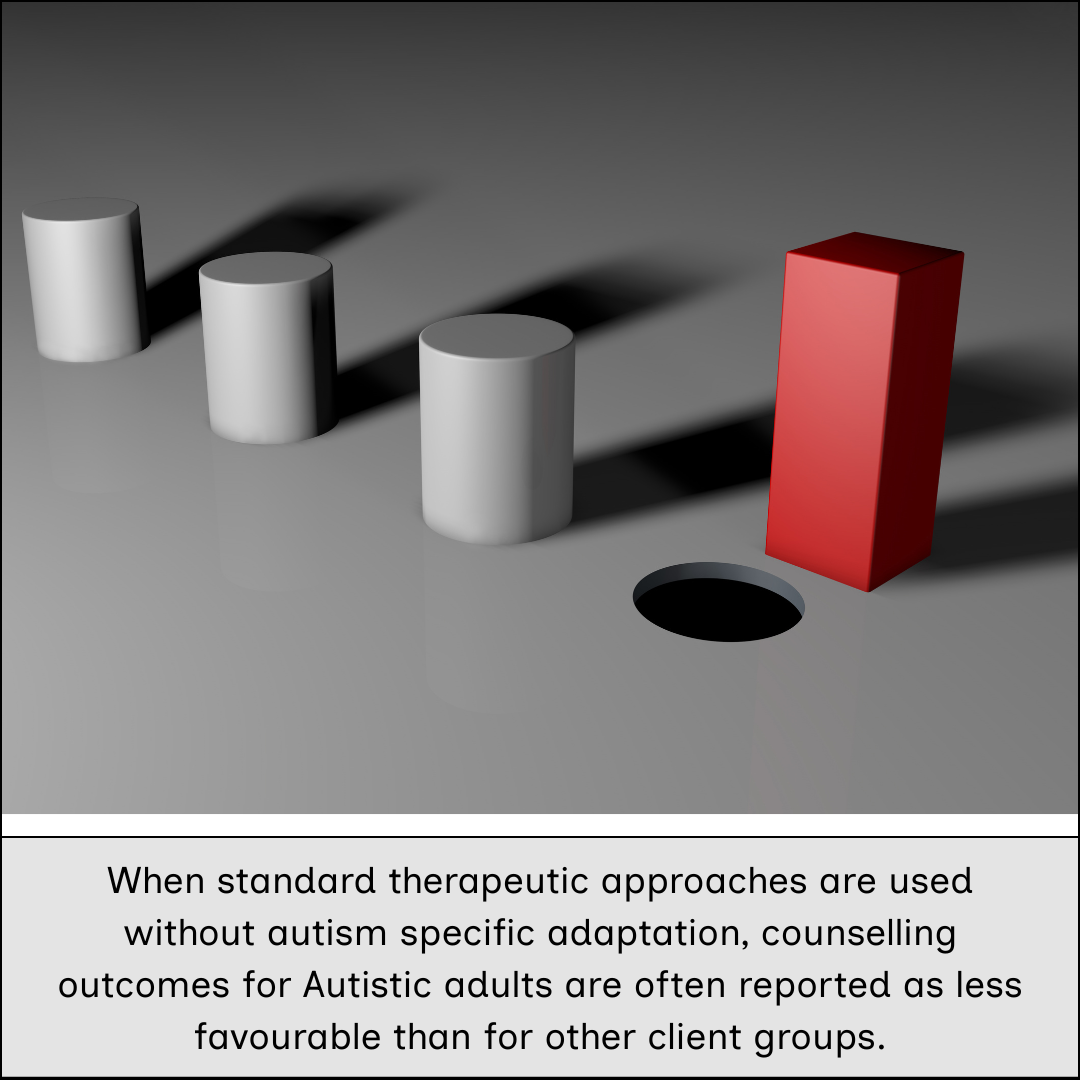
Without specialised training, therapy can reproduce this imbalance. Instead of being a space for repair, it becomes another context in which Autistic adults must explain themselves, manage others’ misunderstandings, and absorb the cost.
When this happens, therapy does not merely fail to help; it becomes part of the problem.

Interested in learning more? Join my 2-day workshop!
References
Brosnan, M., & Adams, S. (2022). Adapting drug and alcohol therapies for Autistic adults. Autism in Adulthood, 4(3). https://doi.org/10.1089/aut.2021.0047
Camm‑Crosbie, L., Bradley, L., Shaw, R., Baron‑Cohen, S., & Cassidy, S. (2019). Autistic adults’ experiences of accessing and receiving mental health services. Autism, 23(6), 1431–1441. https://doi.org/10.1177/1362361318816053
Hume, R. (2022). Show Me the Real You: Enhanced Expression of Rogerian Conditions in Therapeutic Relationship Building with Autistic Adults. Autism in Adulthood, 4(2), 151–163. https://doi.org/10.1089/aut.2021.0065
Milton, D. (2012). On the ontological status of autism: The “double empathy problem”. Disability & Society, 27(6), 883–887. https://doi.org/10.1080/09687599.2012.710008
Price, D. (2022). Unmasking Autism: Discovering the New Faces of Neurodiversity. Harmony Books.